
Angle Type Solenoid Valves Dealer
Introduction
Established in 2005, Ammar Industrial Corporation is an authorized supplier, wholesaler, dealer, stockist, distributor, and retailer of precision-engineered pneumatic-hydraulic-instrumentation-automation products and industrial process equipment based in Kolkata. Our range includes Air Preparation Unit, Pneumatic Solenoid Valve, Pneumatic Cylinder Actuator, hydraulic tools, fluid automation solenoid valves, etc. Our quality norms enable us to maintain and enhance our position in today’s competitive market. Ammar Industrial Corporation’s premium quality products are recognised as the most reliable. Moreover, we follow a quality policy to monitor these products before delivering them to customers.
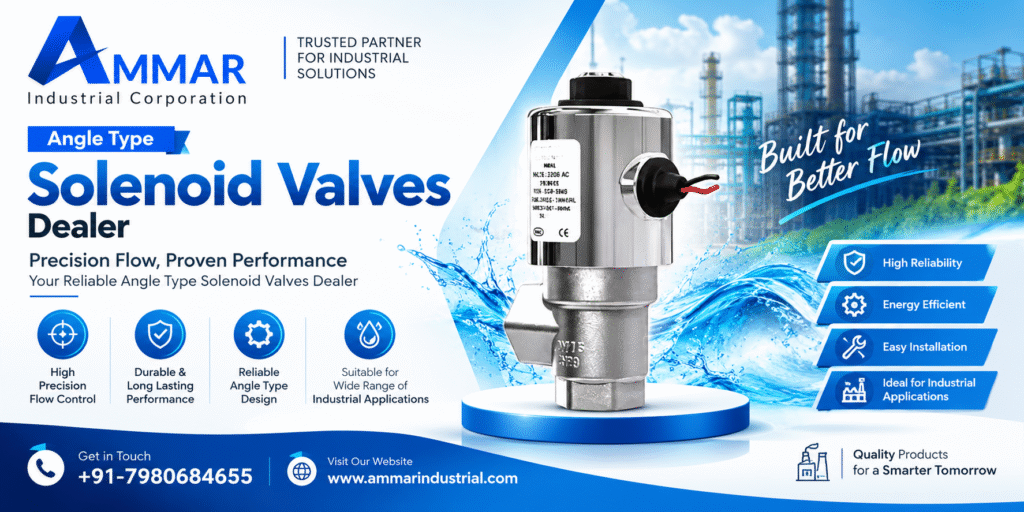
Solenoid valves are important components used in many industrial systems for controlling the flow of liquids and gases. Among different types of solenoid valves, angle-type solenoid valves are widely preferred for applications where space, efficient flow control, and easy installation are important. Choosing the right Angle Type Solenoid Valves Dealer can help industries get reliable products, proper technical guidance, and consistent performance.
Ammar Industrial Corporation is a trusted supplier and dealer offering quality industrial valves and fluid control solutions for different industrial requirements. With a focus on product quality, customer satisfaction, and dependable service, the company serves customers looking for reliable valve solutions.
What Are Angle Type Solenoid Valves
An angle type solenoid valve is an electrically operated valve designed to control the flow of fluids or gases through a piping system. It uses an electromagnetic coil to open or close the valve when an electrical signal is supplied.
The inlet and outlet ports of an angle-type solenoid valve are positioned at an angle, generally around 90 degrees. This design makes the valve suitable for piping systems where a compact arrangement is required. These valves can be used to control water, air, steam, oil, chemicals, and other compatible media, depending on the valve material, seal, pressure rating, and design.
Why Choose Ammar Industrial Corporation
1. Wide Range of Valve Options
- A reliable Angle Type Solenoid Valves Dealer should offer a comprehensive range of valves suitable for different industrial requirements. Customers may require different port sizes, body materials, operating pressures, temperature ratings, coil voltages, and connection configurations. Having multiple options under one source makes it easier to select a valve according to the exact requirements of the piping and automation system.
2. Reliable Product Quality
- Valve quality directly affects the reliability of an automated fluid-control system. A good dealer focuses on products manufactured with durable materials and tested for proper operation, sealing, and electrical performance. Quality valves can provide consistent switching performance and help reduce the possibility of leakage, premature failure, and unexpected production interruptions.
3. Expert Product Selection Assistance
- Selecting a solenoid valve is not simply about choosing the correct pipe size. Factors such as media type, pressure, temperature, flow rate, electrical supply, operating frequency, and compatibility of sealing materials should also be considered. An experienced dealer can understand the application and recommend a suitable valve specification instead of offering a one-size-fits-all solution.
4. Suitable for Space-Constrained Installations
- The angled configuration can provide greater flexibility when designing or modifying piping systems. Angle valves can combine flow control with a change in flow direction, which may reduce the requirement for additional fittings in certain installations. This makes them useful for machinery, equipment panels, process lines, and installations where available space is limited.
5. Fast and Efficient Fluid Control
- Solenoid-operated valves are widely used where automatic and rapid ON/OFF fluid control is required. They can be integrated into automated systems to control water, air, gases, oils, and other compatible media. For automated production equipment, reliable switching helps maintain consistent operating sequences and supports efficient process control.
6. Durable Performance
- Industrial valves may operate continuously under demanding conditions. Depending on the selected construction, angle-type valves can be supplied for applications involving different pressures, temperatures, and media. For demanding applications, selecting the correct body and sealing material is essential for achieving reliable service life. Industrial valve suppliers commonly provide options such as brass or stainless-steel constructions depending on the application.
7. Better Automation Integration
- Modern industries increasingly depend on automated processes. Solenoid valves can be integrated with control panels, sensors, timers, PLC systems, and other automation components to provide automatic fluid switching. This reduces the need for continuous manual intervention and allows fluid-control operations to become part of an automated production sequence.
8. Reduced Maintenance Requirements
- A properly selected and correctly installed valve can help minimise maintenance problems. Reliable construction, suitable sealing materials, and correct operating conditions contribute to longer service life. A knowledgeable dealer can also help customers understand installation, operating conditions, replacement requirements, and basic maintenance practices.
9. Competitive Pricing
- Working directly with an experienced Angle Type Solenoid Valves Dealer can provide access to competitive pricing for individual requirements as well as bulk industrial orders. For manufacturers, OEMs, contractors, distributors, and system integrators, a dependable supply partner can help maintain inventory availability while controlling procurement costs.
10. Customised Solutions
- Different industries have different operating requirements. In some cases, standard valves may not perfectly match the application. An experienced dealer can help identify suitable configurations or coordinate with manufacturers for application-specific requirements. This can be particularly useful for specialised machinery and automated process systems.
11. Long-Term Business Support
- A good dealer should be viewed as a long-term technical and supply partner rather than simply a product seller. Reliable communication, timely quotations, product guidance, after-sales assistance, and dependable supply can make a significant difference to industrial customers.
Applications of Angle Type Solenoid Valves
1. Water Treatment Plants
- Angle Type Solenoid Valves are commonly used in water treatment and purification systems for controlling the flow of water through different stages of the treatment process. They can be installed in filtration, dosing, flushing, and automated water distribution systems where precise and dependable flow control is important.
2. Pneumatic Systems
- These valves are extensively used in pneumatic equipment to control compressed air. They help automate the operation of pneumatic cylinders, actuators, air-operated machinery, and other components. Their quick response makes them suitable for applications requiring frequent switching and automated air control.
3. Industrial Automation
- Angle Type Solenoid Valves are an important component in automated production systems. They can be connected with sensors, PLCs, and control systems to regulate the movement of fluids or gases automatically. Industries use them to improve operational efficiency, reduce manual intervention, and maintain consistent process control.
4. HVAC and Cooling Systems
- In heating, ventilation, and air-conditioning systems, these valves can control the flow of water, refrigerant-related fluids, or other compatible media. They are useful in automated temperature-control systems where fluid flow needs to be regulated according to changing operating conditions.
5. Steam Control Applications
- Specially designed Angle Type Solenoid Valves can be used in steam-control applications. They are suitable for controlling steam flow in industrial equipment, heating systems, sterilization units, and process machinery, provided the valve materials and temperature ratings are appropriate for the application.
6. Boiler Systems
- Boiler and heating equipment often require automatic control of water, fuel-related fluids, or other media. Angle Type Solenoid Valves can be incorporated into these systems to provide dependable ON/OFF flow control and support automated boiler operations.
7. Chemical Processing Industries
- These valves are used in chemical processing equipment for controlling compatible chemicals and process fluids. Depending on the application, valves manufactured from suitable corrosion-resistant materials can provide reliable operation in dosing, mixing, transfer, and process-control systems.
8. Food and Beverage Processing
- Food and beverage manufacturing plants use solenoid valves in automated washing, filling, cleaning, dispensing, and processing equipment. When the appropriate hygienic materials and specifications are selected, Angle Type Solenoid Valves can help maintain controlled and repeatable fluid flow.
9. Pharmaceutical Industries
- Pharmaceutical manufacturing requires accurate and automated fluid management. Angle Type Solenoid Valves can be used in process equipment, cleaning systems, water handling units, and other applications where controlled flow operation is required. Material compatibility and cleanliness are particularly important in these installations.
10. Washing and Cleaning Equipment
- Industrial washing machines, vehicle washing systems, cleaning equipment, and automated cleaning lines use solenoid valves to control water and cleaning-fluid flow. Angle Type Solenoid Valves allow the equipment to automatically start or stop the required fluid supply during different cleaning cycles.
11. Irrigation Systems
- Automated irrigation systems use solenoid valves to control water distribution to different zones. Angle Type Solenoid Valves can be integrated with timers, controllers, and sensors to automate irrigation schedules and reduce unnecessary water consumption.
Benefits of Angle Type Solenoid Valves
1. Compact and Space-Saving Design
- One of the major benefits of Angle Type Solenoid Valves is their compact design. The angled configuration can make piping easier in areas where conventional straight valves may require more installation space. This makes them suitable for compact industrial equipment, automation systems, and machinery.
2. Fast and Automatic Flow Control
- Angle Type Solenoid Valves operate through an electromagnetic solenoid mechanism. They can quickly open or close the flow of fluids when an electrical signal is received. This allows industries to automate fluid control processes and reduce the need for manual valve operation.
3. Easy Installation
- The angled inlet and outlet design can simplify pipe routing in certain installations. A professional Angle Type Solenoid Valves Dealer can help customers select the appropriate connection size and valve configuration for easier integration with existing pipelines.
4. Reliable Performance
- These valves are designed to provide consistent operation during repeated opening and closing cycles. When properly selected and maintained, they can deliver reliable performance in industrial automation, water control, pneumatic systems, and other fluid-handling applications.
5. Suitable for Automation Systems
- Angle Type Solenoid Valves are particularly useful in automated systems. They can be connected to controllers, sensors, timers, PLC systems, and other automation equipment. This enables automatic control of fluid flow according to predefined operating conditions.
6. Efficient Fluid Management
- Automatic operation helps control the flow of air, water, gases, and compatible liquids more efficiently. The valve opens only when required and closes when the electrical signal is removed, depending on its operating configuration. This can help improve process control and reduce unnecessary fluid flow.
7. Reduced Manual Intervention
- Because these valves can be electrically operated, operators do not need to manually open or close the valve every time flow control is required. This is especially useful in production environments where valves need to be operated frequently or from a remote control system.
8. Better Piping Flexibility
- The angled configuration can provide additional flexibility when designing or modifying a piping system. It can help change the direction of flow while maintaining automatic valve control, which may be beneficial in equipment with limited piping space.
9. Low Maintenance Requirements
- Quality solenoid valves are generally designed for dependable operation with relatively low routine maintenance. Regular inspection, cleaning, and checking for leakage can help maintain valve performance and extend its service life.
10. Available in Different Specifications
- A reputed Angle Type Solenoid Valves Dealer can provide valves in different sizes, connection types, operating pressures, voltage options, body materials, and seal materials. This makes it easier for customers to select a valve that matches their specific operating conditions.
Types of Angle Type Solenoid Valves
1. Direct Acting Angle Type Solenoid Valves
Direct-acting angle-type solenoid valves operate directly through the electromagnetic coil. When the coil receives an electrical signal, the plunger moves and opens or closes the valve. These valves do not require minimum pressure to operate.
- Water control systems
- Small pneumatic equipment
- Laboratory equipment
- Low-pressure piping
- Automatic dispensing systems
2. Pilot Operated Angle Type Solenoid Valves
Pilot-operated valves use the pressure difference in the pipeline to open and close the main valve. The solenoid coil controls a smaller pilot opening, which then controls the main flow.
- Industrial water systems
- Compressed air systems
- HVAC systems
- Process industries
- Automatic machinery
3. Semi-Direct Acting Angle Type Solenoid Valves
Semi-direct acting solenoid valves combine features of direct acting and pilot-operated valves. The electromagnetic force assists the diaphragm or piston, while the pressure in the system also contributes to valve operation.
- Industrial automation
- Water treatment equipment
- Air handling systems
- Chemical processing
- General fluid control
4. Normally Closed (NC) Angle Type Solenoid Valves
In a normally closed valve, the passage remains closed when the solenoid coil is not energised. When electrical power is supplied, the valve opens and allows the medium to flow.
- Automatic water control
- Fuel control systems
- Air compressors
- Irrigation systems
- Industrial machinery
5. Normally Open (NO) Angle Type Solenoid Valves
Normally open angle type solenoid valves remain open when the coil is de-energised. When the coil receives power, the valve closes.
- Safety systems
- Cooling systems
- Ventilation equipment
- Industrial process lines
- Emergency shut-off systems
Conclusion
Angle-type solenoid valves provide an effective solution for automated fluid and gas control. Their compact angled design, quick operation, and compatibility with automation systems make them useful for many industrial applications. However, choosing the correct valve requires careful consideration of factors such as media, pressure, temperature, port size, voltage, and material.
If you are looking for a dependable Angle Type Solenoid Valves Dealer, Ammar Industrial Corporation can be a suitable source for your industrial valve requirements. With a focus on quality products and customer-oriented service, Ammar Industrial Corporation aims to provide practical valve solutions for different industrial applications. For your next industrial valve requirement, choose the right product, work with a reliable dealer, and ensure your fluid control system operates efficiently and consistently.